


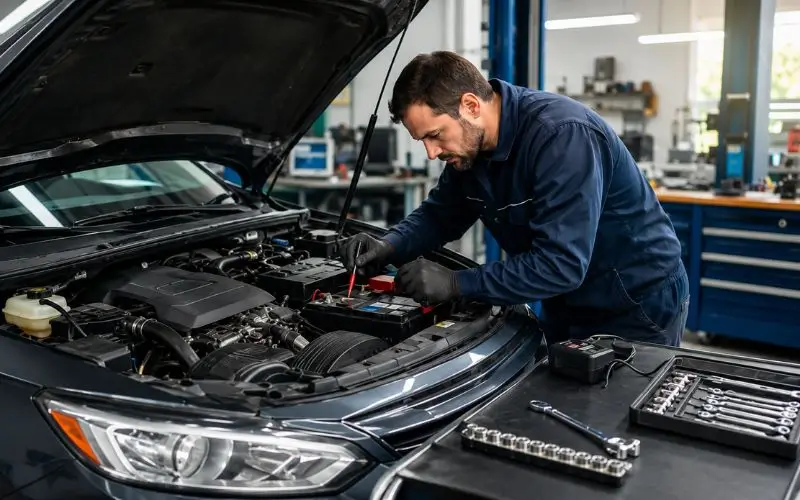
The slow engine cranking during hot weather can affect how the car starts every time. Heat above 40degC increases electrical resistance within the starter motor, battery and wiring harness. Every time you try to start the engine, it receives less current and takes longer for it to reach ignition threshold.
In modern cars, the computer (ECU), which is used to start the motor, requires a steady supply of power. The crankshaft sensor will slow down if the voltage is low. This will cause the engine to not start smoothly. Your car will struggle to start or turn on.
Understanding the concept of slow engine Cranking
Slow cranking is when the starter motor spins down the crankshaft to below 200 RPM at the time of ignition. It takes too long for the engine to start and it sounds weak. Healthy engines crank and start within 0.5-1.5 seconds after pressing the BCM button or turning the key.
A slow start of more than 2 seconds confirms the presence of electrical faults which require immediate diagnosis. Each slow start draws an additional 50 to 80 amps beyond the normal startup current.
Why does hot weather increase slow cranking in cars?
The hot weather can make slow cranking worse by causing three direct heat effects to the battery, starter, and charging system. In Dubai, engine bay temperatures can reach up to 80degC between 12pm and 4pm during the peak hours of June to September.
The 3 main thermal effects are:
- Heat above 45degC increases battery internal resistance by 30%, and reduces the cranking current of the starter motor
- Heat in the engine bay above 70degC causes oil to thicken and the starter to have to work harder by 40% to turn the crankshaft
- Heat wears out solenoid contacts and starter motor brushes, reducing current flow by up to 20%
What are the 7 warning signs that drivers ignore before a complete ignition failure?
In hot weather, drivers often ignore warning signs of ignition system failure. Early diagnosis can improve starter efficiency, battery stability and engine cranking.
- If the crank time is above 2 seconds, the engine will not start on the first attempt.
- The starter solenoid makes a clicking sound, but it does not grab the ring on hot starts.
- When the ignition key is turned to the START position, the battery voltage will drop.
- The engine will start fine in cold temperatures, but it will slow down after 30 minutes of heat.
- When the solenoid pulls high-current, AC compressor load drops, blower speeds fall.
- If the voltage gauge is below 11V, it means that the OBD voltage falls below 11 volts when the engine is cranking.
- The battery requires an external boost at least once per week, if not more.
What happens inside the battery when slow cranking is ignored?
Stage 1: Lead Plates Sulfate
When battery voltage falls below 12,4 volts, crystals of lead sulfate grow on the positive and negative plates. Every slow crank adds an additional 5% PbSO4 onto the plates. Sulfation reduces CCA production by 30% within 4 to 6 weeks.
Stage 2: Electrolyte stratification reduces cell output
When the temperature rises above 40degC, battery acid separates into two layers: a dense bottom layer and a weaker top layer. The EMF of each cell drops from 2.1 to 1.8 volts when the acid is stratified. With full acid stratification, a 6-cell battery only gives 10.8 volts as opposed to 12.6 volts.
Stage 3: Active material shedding reduces capacity
Lead dioxide is deposited at the bottom of each cell after deep discharge cycles. Shed material on the plate grids can cause internal short circuits in 3 to 4 of the cells. Battery loses 40% CCA rating within 3 months.
Thermal Runaway Breaks Full Batteries in Stage 4.
The alternator voltage regulator must push the battery above 15 volts in order to charge it. Electrolyte gassing inside AGM and EFB sealed units is accelerated by 50% when the battery voltage is raised above 15 volts. When the cell heat reaches 60degC full failure will occur in 7-14 days.
What Happens to the Starter Motor When It is Ignored to Slow Crank?
Affected by slow cranking, the starter motor draws 300 – 400 amps per start compared to 150 – 200 amps per normal start. This high current will burn out the armature windings, and pit the commutator surface in 3 to 6 weeks of repeated hard starts.
The replacement of starters in Dubai workshops depends on their defect and the car model. Cost savings for replacement of the root battery fault via replacement of the AGM unit are substantial as compared to full starter motor replacement costs.
Effects of Slow Cranking on ECU and Ignition Stability
When attempting to start for an extended period the battery drops below 9.6 volts due to slow cranking. Fuel injector pulse width and ignition coil dwell time are stable at 9 volts or greater on the ECU. If the voltage is below this, then there are 3 fault responses: fuel injector delay, ignition coil shutdown and ECU KAM reset.
ECU KAM reset wipes adaptive fuel trim data built up over many kilometres of driving. The engine needs to learn this information in the first 200-300 km and increases fuel consumption by 8-12% for the first 200-300 km.
Professional Diagnostic Importance in UAE Conditions
3 key pieces of equipment are employed in battery diagnostics in UAE heat: carbon pile load testers, OBD voltage scanners and conductance meters, all looking for hidden faults before they reach full ignition failure. The carbon pile load test, with 50% CCA rating, verifies battery health in less than 3 minutes.
A properly performed diagnosis every 6 months will detect a failing battery 4 to 6 weeks before it fails to crank. 800 Car Battery Replacement is an authorized car battery replacement services in Abu Dhabi and UAE that offers load testing services to assure vehicle reliability.
Read Also: Al Jafiliya Bus Station
Final Thoughts
If the engine cranks slowly in hot weather, this indicates that something is failing with the battery, not just a little delay starting. The sulfation of PbSO4, acid stratification of the electrolyte and the thermal runaway of the cell occur more rapidly in the UAE heat (>45°C) than in any other climate scenario.
Open circuit voltage drops and CCA loss are detected before complete ignition failure with diagnostic testing every 6 months. If the battery is below 12.2 volts when it is not being used, it needs to be loaded right away.
