


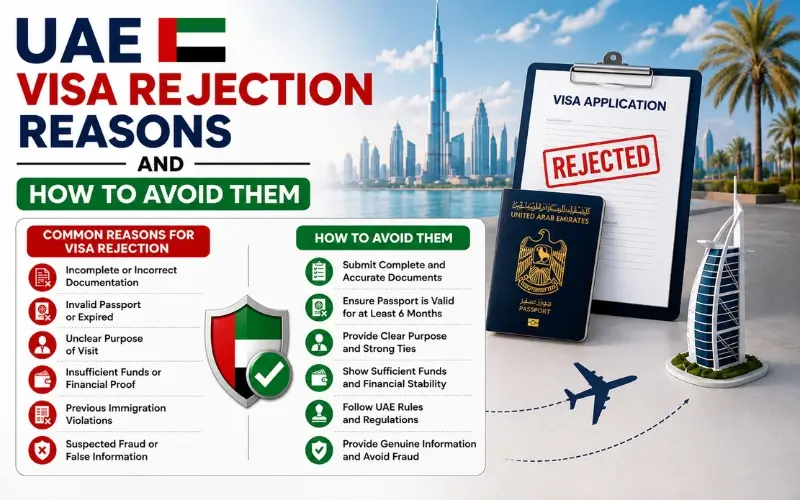
UAE visa rejections are frustrating, costly and, in most cases, completely avoidable. Even minor errors can lead to an automatic rejection when applying for a visa. This is true whether you are applying for a visa or other immigration permit such as a family residency visa, student entry permit, employment visa, etc. The smartest thing you can do before reapplying for a visa after rejection or before submitting a first application is to check UAE visa status via the official ICP and GDRFA portals. This will help you understand where you stand, whether there are any bans or outstanding fines or previous application flags that may affect your outcome.
The big picture of why UAE visa applications are rejected
The UAE immigration authorities, primarily ICP for non-Dubai Visas and GDRFA Dubai for Dubai Permits, use automated verification systems that cross-reference multiple government databases. These systems cross-reference your application against multiple government databases including passports, travel histories, UAE immigration records and security databases. They also check medical fitness results as well as sponsor eligibility.
Multiple government departments are involved in the process, including MOHRE, GDRFA (Ministry of Human Resources and Emiratisation), medical screening centers, and federal security databases. The reasons why applications are rejected usually stem from issues that affect multiple government agencies, rather than one factor.
Rejection reason 1: Incomplete or inaccurate personal information
Incomplete or inaccurate information is one of the main reasons why visa applications are rejected. Automated rejections can be triggered by errors such as misspellings, incorrect passport numbers or dates of birth.
Rejection will be issued for any mistake in name, passport number or date of birth. When any details do not match the requirements of UAE systems, visas will be denied. This can lead to system errors or suspicion.
Common data input errors that lead to rejections:
- The passport spelling of the first or last name is different
- When entering MM/DD/YYYY, the system will expect DD/MM/YYYY.
- Transposed or missing digits in a passport number
- Incorrectly entered nationality
- Name discrepancy in different documents, for example your passport may show the full legal name but your airline ticket shows a shortened version.
What to do if you see it?
Check your application several times before submitting. Check each field with your passport, not just from memory. Make sure the name entered matches exactly what is on your passport, including middle names or special characters. Complete all fields. Missing fields can result in an automatic rejection.
Rejection 2: Documentation incomplete or of poor quality
Visas will be denied if they do not have copies of the passport, photos, or proof of travel. The authorities require full documentation to verify travel purpose and identity. Any missing file could result in an automatic rejection.
Unclear copies of passports, low-resolution photos, missing attestations or incomplete supporting documentation can lead to UAE visa applications being rejected or delayed. Immigration authorities demand clear, verifiable documents.
Common document problems that lead to rejection:
- The scan of a passport at low resolution must be 300 DPI or higher for clarity.
- Photo that does not comply with UAE specifications: wrong background color, dimensions, face centered, or wearing sunglasses
- The uploaded copy of the passport must include all pages containing biographical information and previous UAE visa stamps.
- Documents in the wrong format or file sizes exceeding limits
- Forms that are not signed or do not have the required stamps and attestation
- Supporting documents that are expired include bank statements older than 3 months, employment letters with no current date or tenancy agreements that have expired.
Rejection reason 3: Passport issues
Some common passport and documentation issues that can lead to a rejection are: passports with a validity of less than six month, not enough blank pages on which visas can be stamped, differences in the spelling of names across documents, damage or signs indicating tampering, and expired supporting documentation.
Specific rejection triggers for passports:
- Insufficient Validity: UAE Immigration requires a passport with a validity of at least six month beyond the travel or stay period. Even if technically valid, a passport that expires in less than four months is rejected.
- No blank page: A passport must have two blank pages for stamping visas. Complete passports will be rejected.
- Physical Damage: A passport that is torn or damaged by water, or looks tampered with, will raise immediate flags for the verification system.
- Mismatch of names on documents: For example, if your passport says “Mohammed Ali Hassan”, but your airline ticket states “M.A. Hassan, the discrepancy may cause a rejection even though they both refer to the exact same person
Rejection Reason 4: Insufficient Financial Proof
The UAE immigration authorities must be convinced that the visa applicant is financially capable of supporting themselves and has a valid reason for returning home. Financial documentation that is weak or unconvincing is one of many reasons why visas are rejected for tourists and visitors.
Weak financial proof:
- Bank statements with very low balances or inconsistencies
- Bank statements that do not cover the three-month minimum period
- Without a regular salary, there is no pattern of income.
- Official statements missing bank stamp or signature
- Savings below the threshold expected for the duration of the stay
What to do if you see it?
Bank statements for the last three months should show consistent and adequate balances. The recommended minimum balance for UAE visa applications varies, but a consistent amount of AED 3,001 to AED 5,001 is required. You should only use official bank statements, not PDFs generated by online banking portals. When your balance is on the borderline, combining bank statements and salary certificates will strengthen your overall financial picture.
Rejection reason 5: Previous visa overstays or immigration violations
Visa rejection can be a result of personal history factors such as previous visa overstays, criminal records or legal issues. Other reasons include a history of immigration or deportation violations and prior UAE visa rejections.
Rejection based on prior history:
Even if you overstayed your visa years ago, the violation will be recorded in the UAE Immigration database. The ban can range from six months up to a permanent period depending on how long the overstay was and what resolutions were made. If you apply for a new visa to the UAE without checking this history and solving it, your application will be automatically rejected.
What to do if you see it?
Before applying, check your UAE immigration status on the official ICP Smart Services or GDRFA Dubai portal. Resolve any outstanding cases and clear all fines. Wait until the ban period expires. Be transparent and give evidence of any previous visa issues.
The unified AED $50 per day fine, introduced in February 2026, applies to UAE-specific overstay penalties. Before a new application can be considered, all outstanding fines have to be paid via the ICP portal or GDRFA.
Rejection reason 6: Applying to the wrong visa category
Dubai has multiple visa categories. Selecting the wrong one can lead to refusal. The most common mistake that can result in rejection is applying for the incorrect visa.
Common category mismatch scenarios:
- When you are actually going to a business meeting, you need a business visa.
- It is illegal to apply for a visa for employment while on a tourist visa. Applications that indicate employment intent when applying for tourist status will be rejected.
- The applicant intends to study while on the visa.
- When multiple trips are planned and a visa for single entry is required, the permit expires.
What to do if you see it?
Define your purpose of travel and apply for a visa that matches it. Consult the UAE immigration guidelines for the correct category when combining leisure and business trips. If you are going to be working, then apply for the right work permit through your employer. Do not use a tourist visa and convert later.
Rejection reason 7: Sponsor-Related issues
The sponsor’s standing with UAE authorities will directly impact the approval of the visa application.
Issues with the sponsor of an employment visa that lead to rejection:
Some common errors are incorrect profession coding and insufficient salary declarations. Other mistakes include missing establishment cards and quota exhaustion. Can an UAE visa be denied due to a mismatch in profession? If the occupation on the work permit doesn’t match the role played, then the application will be rejected.
Issues relating to visa sponsors and residence:
- Sponsor’s residence visa expires soon or has expired
- The sponsor has unpaid fines or a legal hold
- Sponsor’s Emirates Id is not renewed or expired
- Companies with trade licenses that have been suspended or not renewed
- The resident sponsor’s salary is below the minimum threshold for sponsoring dependents
What to do if you see it?
Before submitting your application for an employment visa, check with your employer to ensure that all details are correct, including the establishment card, quotas and codes of profession. To sponsor family residence, you must ensure that your visa, Emirates ID and salary certificate (for self employed sponsors) are current and valid. UAE immigration has a minimum threshold salary for sponsors of dependents. Confirm that your salary is within the threshold by speaking to your HR or authorised immigration consultants.
Rejection 8: Medical Fitness Issues
UAE visa rejections are based on medical grounds primarily for residency and employment applications. Primary triggers include active tuberculosis or HIV-positive status, for both work and residency visas.
Even if the applicant is in perfect health, a UAE visa refusal medical result can also occur when the test was conducted at an unapproved facility.
What to do if you see it?
Do your medical fitness tests only at medical centres approved by the MOHAP. Before booking an appointment, confirm the approval status of the medical centre. Bring your Emirates ID card, passport and medical test referral number to the appointment. Consult an immigration medical specialist to determine how your pre-existing condition is classified by UAE immigration standards.
Rejection reason 9: Security and background check flags
Some visa refusals are security related and not disclosed to the applicant in detail. Some of these include criminal records either in the UAE, the applicant’s country or both, deportations from the UAE, or UAE partner countries, associations with flagged people or organisations or travel histories from countries that trigger extra security screening.
UAE Immigration’s 2026 Verification Protocol includes stricter background checks for employment and residence applications.
What to do if you see it?
In all fields of the application, be completely honest about your travel history, background, and previous immigration issues. Before applying, address any past immigration violations. If you try to hide relevant information, the result could be a permanent ban that is much more severe than your original problem.
For applicants from high-security-scrutiny nationalities, ensure that all documentation is complete and professionally prepared, and consider using an authorised PRO (Public Relations Officer) service or legal immigration consultant to present your application in the strongest possible way.
Rejection 10: Intent to Travel and Return Ties not Established
The UAE authorities must be convinced that you will leave the UAE when your visa expires. The UAE rejects visa applications that show the risk of an applicant exceeding their allowed period.
The UAE immigration will only accept a confirmed flight booking, not an itinerary in progress, a screenshot of a price comparison, or a search result. The booking must have a PNR (Passenger Record) that can be verified. When applying for a visa, the UAE requires travellers to submit their confirmed hotel reservations as well as return flight tickets on the immigration portal.
Return ties with weak return ties raises flags:
- Booking confirmed return flights or subsequent travel
- No clear ties with the home country, no stable employment, family obligations, or property or assets
- The applicant has overstayed UAE visas or other visas
- Uncertain or recent employment situation in your home country
- Multiple UAE visas in a short time with minimal stay
What to do if you see it?
Include a confirmed flight return booking with a PNR that can be verified. Include a confirmed hotel reservation for your entire stay. Include documents that show strong ties with your home country, such as a letter of employment, a property document, registries for family members, or long-term lease agreements. An itinerary that is logical and clear for your UAE visit will demonstrate genuine intent to travel or visit.
Check UAE Visa Status before Reapplying
Checking your UAE visa status and immigration is an important step before submitting a new application, whether you received a rejection letter or want to confirm your current standing.
Check via ICP Smart Services (non-Dubai applications): Go to smartservices.icp.gov.ae. Navigate to Public Services, and then select File Validity or Status Inquiry. Enter your passport number and expiry date. You will see your current status, including any fine flags or active applications.
Status inquiry via GDRFA Dubai: Navigate to gdrfad.gov.ae. Enter your passport number, and nationality. You will be able to see your Dubai visa status and any outstanding fines.
Check with UAE PASS for all emirates: Log into the UAE PASS App and select Documents. Then, click on Visa and Residency. The dashboard displays all linked entry permits and visas along with their current status.
You can address any outstanding fines via the same portals after you have checked your status. UAE immigration requires at least 48 hours between applications.
What to do after a UAE Visa Rejection
Step 1. Identify the exact reason Ask the visa center, typing centre or authority who processed your application for the reason of rejection. Before you can address the problem, it is important to understand what caused the rejection. Reapplying without addressing the root cause almost always results in the same outcome.
Step 2: Addressing the root cause
- Re-scan and reattest documents with errors.
- To prove your financial status, you can provide a three-month bank statement or a new balance.
- Wait until the ban period expires and pay any outstanding fines.
- Renew your passport for passport issues before reapplying
- Consult a MOHAP approved specialist for medical rejections and get a second or third opinion, if necessary.
- Resolve any issues with your sponsor or employer before resubmitting.
Step 4: Reapply after the 48-hour wait UAE Immigration requires that you wait at least 48 hours before reapplying. The waiting period for ban-related refusals can range from six months up to permanent, depending on the severity.
Step 5: Reapply using corrected documentation It is possible to reapply immediately for errors that can be corrected, such as incorrect visa categories, insufficient files or document mistakes. Rejections due to bans are subject to waiting periods ranging from six months up until the end of your life. After correcting errors in documentation, many applicants are successful on their second or third attempt.
Common UAE Visa Application Mistakes: Quick Reference
| Mistake | Impact | Fix |
| The spelling of the name or passport number | Automatic rejection | Triple-check your passport before you submit it. |
| Validity of passports less than six months | Rejected at screening | Renewal of passport is required before applying |
| Document scans at low resolution | Documentation rejection | Scanning at 300 DPI Minimum |
| The wrong visa category | Immediate rejection | Sort by travel purpose |
| Insufficient bank balance | Financial proof rejection | Three-month statements with a consistent and adequate balance |
| Unflagged previous overstay | Background Check Rejection | Clear fines first and wait for the ban. |
| Tests performed at an unapproved location | Medical Rejection | Before booking, confirm that the facility is approved by MOHAP |
| No return flight confirmed | The intent to return is not proved | Book and include a confirmed PNR ticket |
| Sponsor issues still not resolved | Rejection of employment/residence | Confirm the employer quota codes and establishment card |
| Documents missing | Incomplete file rejection | Checklist of official documents for your visa type |
Final Thoughts
Most UAE visa rejections can be prevented. The reasons for visa rejections are categorized into three main categories: document mistakes that could have been prevented by a thorough review, eligibility issues revealed by a pre-application check, and procedural errors caused when applicants do not understand the requirements of their chosen visa category.
If you are applying for a UAE visa in 2026, whether it is for yourself, your family, or a member of staff, take the time to verify the immigration status, collect all required documents, check passport validity, confirm that financial proofs are sufficient, and match visa categories to travel or residency purposes. This preparation will save you weeks of frustration, fees that are rejected, and stress.
Read also:
Etisalat unlimited data for 1 day Package
