


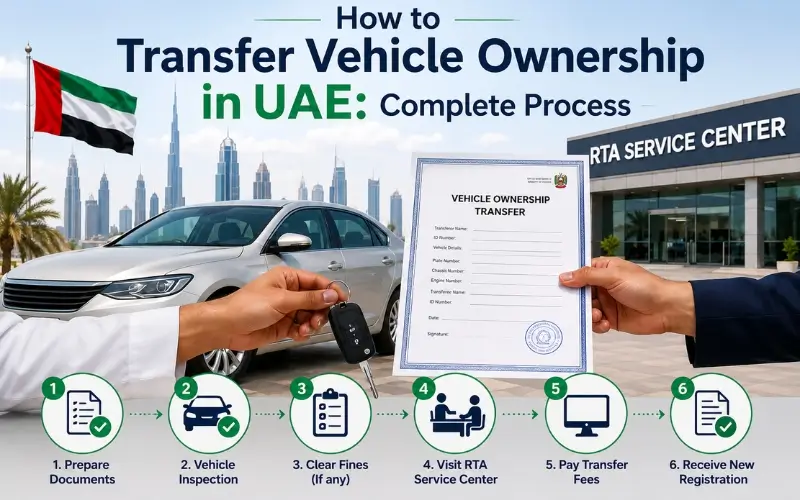
Buying or selling a car in the UAE involves more than exchanging keys and cash. The transaction is only legally complete when the vehicle registration of the Mulkiya is officially transferred to the new owner’s name through the relevant transport authority. Until that transfer is finalized, the original owner remains legally responsible for every fine, Salik toll, accident, and liability connected to the vehicle. One of the most important steps in this process, and one that must happen before anything else, is a thorough EVG fine check to confirm that no outstanding traffic violations are attached to the vehicle. Unpaid fines are a hard stop; no transfer will be approved until they are cleared.
This complete 2026 guide covers the full vehicle ownership transfer process for Dubai, Abu Dhabi, and the other five emirates eligibility rules, required documents, inspection requirements, online and in-person channels, fees, deadlines, special cases like financed vehicles and inter-emirate transfers, and the most common mistakes that cause rejections.
Why Vehicle Ownership Transfer Matters
The Mulkiya is not just a registration document, it is the legal record of who owns and is responsible for a vehicle under UAE traffic law. Skipping or delaying the formal transfer process creates serious risks for both buyer and seller.
For the seller, the risk is straightforward: until the Mulkiya is transferred, any fines, Salik charges, accidents, or violations involving that vehicle remain the seller’s legal liability. Sellers who hand over a car without completing the formal transfer have faced situations where thousands of dirhams in fines accumulate on their record weeks or months after the sale.
For the buyer, driving a vehicle without a Mulkiya in their own name means the car is not properly insured in their name, is not legally registered to them, and could be impounded during a routine traffic check.
The transfer is not optional, and it is not something that can be deferred indefinitely. In Dubai, the buyer has 14 days from submission to complete all licensing steps plate collection and registration before the transaction is cancelled and fees forfeited.
Who Can Transfer Vehicle Ownership in the UAE?
Before beginning the transfer process, both buyer and seller must meet specific eligibility requirements.
Buyer eligibility: A valid UAE residency visa is a must for buyers, and you need to be at least 18 years old, with higher age requirements if you’re after a luxury or heavy vehicle. The right driving licence for your vehicle class is mandatory. Non-residents cannot register a car in their own name.
Eligible buyer categories include:
- UAE nationals and GCC nationals with valid Emirates ID or GCC national ID
- UAE residents with a valid residency visa and Emirates ID
- Companies and businesses with a valid UAE trade licence
- Diplomats with Ministry of Foreign Affairs approval
Seller eligibility: Sellers need to be the legal owners, free and clear of unpaid fines, loans, or mortgages. The seller’s name on the current Mulkiya must match their Emirates ID or official identification documents.
Step 1: EVG Fine Check Clear All Outstanding Violations
Before any ownership transfer can proceed, every outstanding traffic fine associated with the vehicle must be settled. The seller must clear all traffic fines before the transfer can proceed. No transfer happens with unpaid fines; this is a hard stop.
This applies to all violation types: speeding fines, red light violations, illegal parking, mobile phone use while driving, and any other traffic offences recorded against the vehicle’s plate number.
How to check and clear fines by emirate:
Dubai: Check fines through the RTA website or the Dubai Police mobile application. Enter the vehicle plate number or Emirates ID. All outstanding fines will appear with amounts, dates, and any available discount windows. Pay online immediately through the same portal using credit card, debit card, or Apple Pay.
Abu Dhabi: Check fines through the Abu Dhabi Police website, the TAMM government portal, or the Abu Dhabi Police mobile app. Sign in with UAE PASS and enter your vehicle plate number or Emirates ID. All fines linked to the vehicle appear on a single dashboard. Pay online through the portal.
Sharjah, Ajman, Ras Al Khaimah, Umm Al Quwain, Fujairah: Check and pay fines through the Ministry of Interior UAE website or the MOI UAE mobile application. Enter the vehicle plate number or traffic file number. Federal and emirate-specific fines appear together.
After paying fines online: Allow 24 to 48 hours for the payment to reflect in the traffic authority system before proceeding with the transfer. Present payment receipts at the transfer centre if the system has not yet been updated.
Salik and parking: If the vehicle has a Salik account, the new owner must update their details in the Salik system. Additionally, if the vehicle has any Dubai Municipality parking permits, they should be transferred or cancelled. All outstanding Salik toll charges must also be settled before transfer.
Step 2: Obtain a No Objection Certificate for Financed Vehicles
If the vehicle being sold still has an outstanding bank loan or is under a lease arrangement, the existing finance must be settled and a bank clearance letter obtained before ownership can transfer.
This document commonly called a No Objection Certificate (NOC) or bank clearance letter confirms that the financial institution that financed the vehicle has no objection to the ownership change. Without it, the transfer will be rejected regardless of how well-prepared all other documents are.
To obtain a bank NOC:
- Contact your bank or financing institution and request a vehicle clearance letter
- Settle any remaining loan balance or confirm the payoff amount
- The bank issues the NOC processing time varies from same day to five business days depending on the institution
- Present the original NOC at the transfer centre
For vehicles with no outstanding loan owned outright this step does not apply.
Step 3: Vehicle Inspection
Most vehicles require a passing RTA inspection before ownership transfer, unless they fall under specific exemptions such as new cars.
The inspection rule is consistent with the general registration renewal rule: vehicles less than three years old are exempt. Vehicles older than three years must have a valid technical inspection report.
The vehicle must undergo a technical inspection to ensure it meets safety and roadworthiness standards. If the car is over three years old, an RTA-approved test centre will conduct a comprehensive check.
Authorised inspection centres include Tasjeel, Shamil, Wasel, and other RTA-approved facilities across the UAE. The inspection covers brakes, tyres, lights, steering, suspension, seatbelts, emissions, and chassis number verification. A passing inspection certificate is valid for 30 days the ownership transfer must be completed within this window.
If the vehicle fails inspection, address the identified faults at an authorised workshop and return for a re-test. Re-inspection fees are lower than the initial inspection fee.
Step 4: Arrange Insurance in the Buyer’s Name
The buyer needs a valid insurance certificate before arriving at the RTA. Most insurers can issue same-day cover. Third-party is the minimum; comprehensive is recommended for used cars.
The insurance policy must be in the buyer’s name not the seller’s. The RTA system verifies insurance electronically, so purchase the policy through a UAE-licensed insurer that electronically transmits policies to the RTA or EVG system. Allow at least 24 to 48 hours for the policy to appear in the system after purchase.
Step 5: Required Documents for Transfer
You will need the Emirates ID, Mulkiya, valid insurance under the buyer’s name, and a passing RTA test report.
Complete document checklist for both buyer and seller:
Seller must provide:
- Original Emirates ID (and a clear photocopy)
- Original Mulkiya (current vehicle registration card)
- Bank NOC or clearance letter (for financed vehicles only)
- Proof of settled traffic fines (payment receipts if recently paid)
Buyer must provide:
- Original Emirates ID (and a clear photocopy)
- Valid UAE driving licence appropriate for the vehicle class
- Valid insurance certificate in the buyer’s name
- UAE residency visa (for expatriate buyers)
- Trade licence (for company purchases)
For the vehicle:
- Passing technical inspection certificate (for vehicles over three years old, valid within 30 days)
- Gulf Specifications compliance document, if applicable for vehicles originally imported from outside the GCC
If either party cannot be present: Typically both buyer and seller must be present or accompanied with an authorised Power of Attorney (POA) either in the emirate or in their own country. A notarised POA allows an authorised representative to complete the transaction on behalf of an absent party.
Step 6: Complete the Transfer Dubai (RTA Process)
Online via RTA Website or Dubai Drive App
Both parties can complete most steps online through the Dubai Drive app or RTA website using UAE PASS physical attendance is only required if plates are being handed over or the buyer has no existing Traffic File.
Online transfer process:
- Log in to the RTA website or Dubai Drive app using UAE PASS
- Select “Vehicle Licensing Services” → “Change Ownership”
- Verify your identity and confirm all outstanding fines are cleared
- Enter the buyer’s details Emirates ID number and contact information
- The buyer receives a digital agreement link via SMS or email and signs it
- The seller signs and completes the payment of the required fees
- The RTA processes the transfer digitally
- Visit a service centre to complete plate handover and collect the new Mulkiya required if the buyer is collecting physical plates
In-Person at an RTA Service Centre or Testing Centre
At the centre, hand in your documents and settle these fees:
- AED 350 for private car ownership transfer
- AED 20 innovation fee
- AED 400 if you need new number plates
- Additional fees may apply for changes in plate type
Once paid, the RTA will issue a new registration card in the buyer’s name within minutes.
Many authorised testing centres offer a one-stop service vehicle inspection and ownership transfer completed in a single visit saving both buyer and seller a separate trip to the RTA.
A buyer without an existing Dubai Traffic File pays an additional AED 200 to open one.
Step 7: Complete the Transfer Abu Dhabi Process
Transferring vehicle ownership in Abu Dhabi is handled through the TAMM government portal, the Abu Dhabi Police traffic system, or at authorised service centres.
Online via TAMM Portal:
- Log in to the TAMM portal using UAE PASS
- Navigate to “Vehicle Services” → “Vehicle Ownership Transfer”
- Enter the vehicle details and buyer’s Emirates ID
- Confirm all fines and obligations are cleared
- Upload required documents Emirates IDs, Mulkiya, insurance certificate, inspection report
- Pay the transfer fee online
- Receive the digital Mulkiya; physical card dispatched by courier or available for collection at an authorised centre
In-Person at an Abu Dhabi Service Centre:
Visit any authorised vehicle registration centre in Abu Dhabi with all required documents. Both buyer and seller must be present (or with valid POA). Submit documents, complete identity verification, pay fees, and receive the new Mulkiya.
Transfer costs AED 350 to AED 400 for light vehicles, plus AED 170 for the mandatory inspection.
Step 8: Complete the Transfer Other Emirates
For Sharjah, Ajman, Ras Al Khaimah, Umm Al Quwain, and Fujairah, vehicle ownership transfers are handled through each emirate’s traffic authority and can also be managed through the EVG portal for eligible transactions. The general process mirrors the Dubai and Abu Dhabi models fines cleared, inspection passed, insurance in buyer’s name, documents prepared, transfer fee paid, new Mulkiya issued.
Contact the specific emirate’s traffic department for the most current in-emirate process, as online availability varies across the smaller emirates.
Fee Structure for Vehicle Ownership Transfer in 2026
Transferring vehicle ownership in the UAE costs AED 350 to AED 400 for light vehicles, plus AED 170 for the mandatory inspection.
Full fee breakdown by transaction type:
| Transaction | Fee |
| Private car ownership transfer (Dubai) | AED 350 |
| Innovation and Knowledge Dirham fees | AED 20 (AED 10 each) |
| New number plates (if requested) | AED 400 |
| Opening a new Dubai Traffic File (first-time buyer) | AED 200 |
| Vehicle inspection (vehicles over 3 years) | AED 120–200 |
| Re-inspection (if vehicle fails first test) | AED 50–100 |
| Motorcycle ownership transfer | AED 200 (excluding knowledge/innovation fees) |
| Inter-emirate transfer (Dubai to Abu Dhabi) | AED 400–1,000 (Dubai) + AED 100 Abu Dhabi re-registration |
| Power of Attorney notarisation (if required) | Varies |
Always verify the exact current fee at the relevant service centre or online portal, as fees are subject to periodic adjustment.
Inter-Emirate Vehicle Transfers
Transferring a vehicle registered in one emirate to a new owner in a different emirate involves an additional step de-registration in the originating emirate before re-registration in the destination emirate.
For inter-emirate transfers, such as Dubai to Abu Dhabi, costs are AED 400–1,000 (Dubai) plus AED 100 for de-registration and Abu Dhabi re-registration fees.
Process for inter-emirate transfer:
- Clear all fines in the originating emirate
- Complete the transfer to the new owner in the originating emirate’s system
- Obtain a de-registration certificate (vehicle export certificate) from the originating emirate’s traffic authority this officially removes the vehicle from that emirate’s traffic database
- Register the vehicle in the destination emirate present the de-registration certificate, new owner’s Emirates ID, insurance, and inspection certificate
- Pay the re-registration fee in the new emirate
- Receive a new Mulkiya from the destination emirate
The vehicle cannot be driven between completing de-registration in one emirate and completing registration in the new emirate it must be transported. Arrange transport or ensure the registration process in the new emirate is completed before moving the vehicle.
Special Transfer Situations
Gifting a Vehicle to a Family Member
Vehicles can be transferred as gifts within the UAE. The process follows the same steps as a standard private sale: fine clearance, inspection, insurance in the recipient’s name, and Mulkiya transfer at the service centre. The transfer fee applies even for gifts between family members.
Inheriting a Vehicle
When a vehicle owner passes away, the vehicle is transferred to the estate. A Court Order or official inheritance document (issued by the UAE Notary or through the Personal Status Court) is required to authorise the transfer to the heir. Present the court document alongside the standard transfer documents at the relevant traffic authority.
Company Vehicle Transfer
Transfers involving corporate-owned vehicles require the company’s trade licence, an authorisation letter on company letterhead, and the Emirates ID of the authorised signatory. The company must be in good standing with no suspended licences or outstanding government obligations.
Transferring a Vehicle Being Sold Through a Dealer
Authorised car dealers in the UAE handle the entire transfer process on behalf of buyers and sellers. The dealer acts as an intermediary clearing fines if agreed, facilitating inspection, and submitting transfer documentation. Dealer service fees vary. Always confirm in writing which steps the dealer is handling and which remain your responsibility before handing over documents or keys.
Common Mistakes That Cause Transfer Rejections
Not clearing all fines first. This is the single most common reason transfers are rejected at the service centre. Check fines at least 48 hours before the transfer appointment to allow payment to reflect in the system.
Insurance not in the buyer’s name. Some buyers arrive with their own insurance but with the old policy still under the seller’s name. The insurance must specifically cover the vehicle under the buyer’s name before the transfer proceeds.
Expired inspection certificate. The inspection certificate is valid for 30 days. If the certificate was obtained more than 30 days ago, a new inspection is required.
Bank NOC not obtained for financed vehicle. Attempting to transfer a vehicle with an outstanding bank mortgage without a clearance letter will result in immediate rejection. This cannot be resolved on the day the bank must issue the letter in advance.
Missing or mismatched documents. If the name on the seller’s Emirates ID does not match the name on the current Mulkiya particularly after a name change or Emirates ID renewal the discrepancy must be resolved at the traffic authority before the transfer can proceed.
The buyer has no UAE driving licence or wrong licence class. First-time car buyers in the UAE who have not yet obtained a UAE driving licence cannot complete a vehicle registration transfer in their name. Obtain the appropriate licence class before attempting the transfer.
After the Transfer: What Both Parties Should Do
For the seller:
- Confirm that the new Mulkiya has been issued in the buyer’s name and that your name no longer appears in the vehicle’s traffic record
- Contact Salik customer service to remove your details from the vehicle’s toll gate account if not done, future Salik charges may still be directed to you
- Update or cancel any parking permits linked to the vehicle
- Retain your payment receipts and the transfer completion confirmation for your records
For the buyer:
- Verify that the new Mulkiya shows your name, Emirates ID, and the correct vehicle details
- Set up a new Salik account linked to the vehicle plate number
- Update your motor insurance policy reference to reflect the new Mulkiya details
- Set a calendar reminder for the vehicle’s next registration renewal date
- Keep the new Mulkiya in the vehicle at all times you are legally required to carry it while driving.
Final Thoughts
Transferring vehicle ownership in the UAE in 2026 is a well-structured process that protects both buyers and sellers but only when followed completely and in the right order. The most important principle to internalize is this: the sale is not legally final until the Mulkiya is in the buyer’s name. Everything before that moment is a private agreement with no legal protection for either party.
Start with an EVG fine check, settle every outstanding violation, clear any bank loans, confirm insurance is arranged in the buyer’s name, complete the inspection, and then proceed to the transfer channel of your choice. With all conditions met, the actual transfer is completed within minutes online or in person and both parties leave with certainty and legal clarity.
Prepare thoroughly, follow the sequence, and the process is straightforward. Skip a step, and the rejection at the service counter will send you back to the beginning.
Read Also:
