
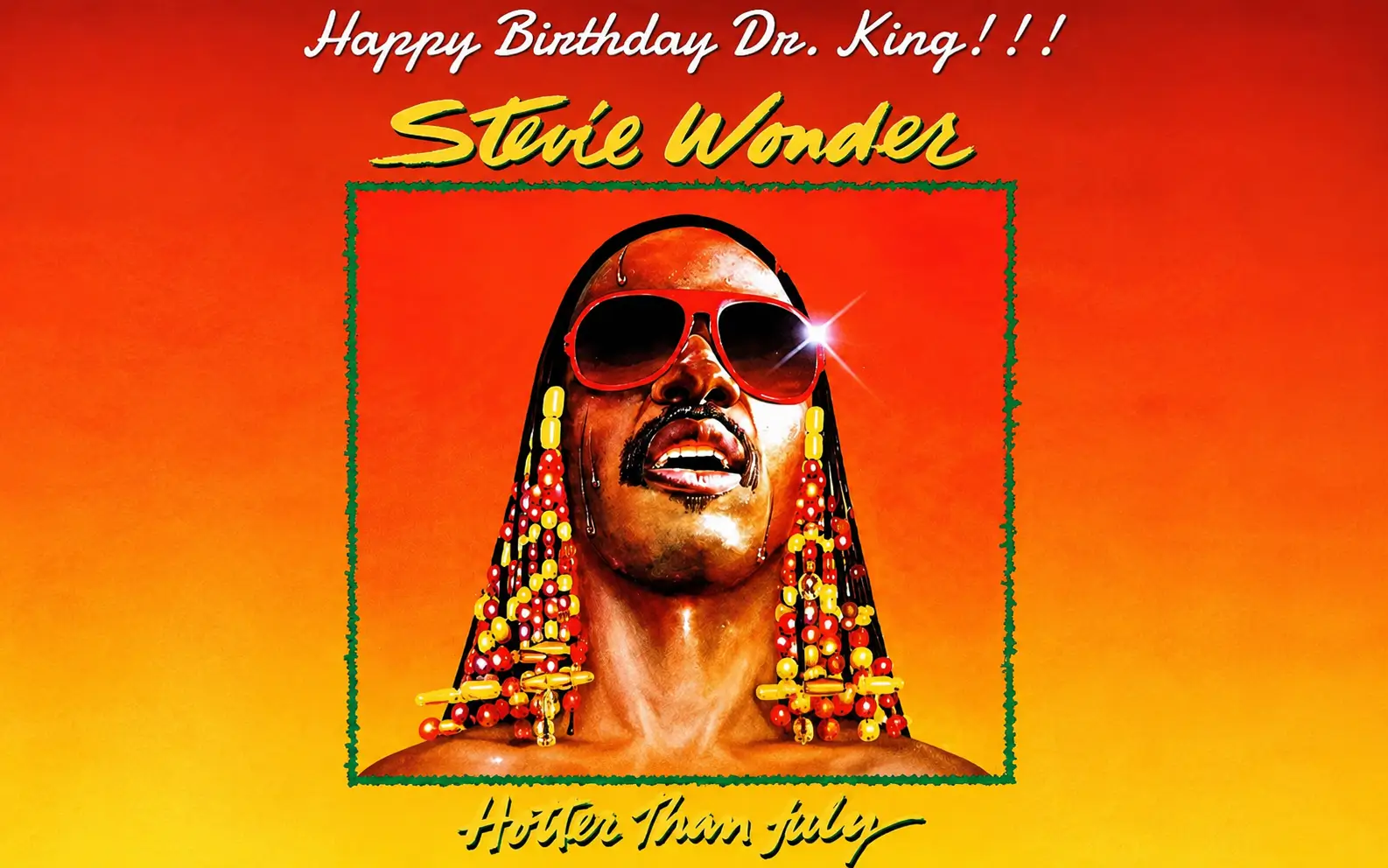
Happy Birthday and Stevie Wonder refers to Stevie Wonder’s famous 1980 song written in support of the campaign to honor Martin Luther King Jr. with a national holiday. Unlike the traditional birthday song used at private celebrations, Wonder’s recording carries a strong historical and social message. It celebrates King’s life and encourages people to recognize his contribution to civil rights and equality. Released on Hotter Than July, the song became an important part of Wonder’s musical career and remains closely associated with King’s birthday and legacy.
The recording is particularly interesting because its title can make it sound like an ordinary birthday celebration. In reality, its purpose was much broader. Stevie Wonder used his popularity as a major recording artist to draw public attention to an important campaign that had continued for years after King’s death.
Who Is Stevie Wonder?
Stevie Wonder is one of the most respected singers, songwriters, musicians, and producers in modern popular music. Born Stevland Hardaway Morris in 1950, he demonstrated exceptional musical ability at an early age and became associated with Motown Records while still a child.His career eventually expanded far beyond his early success. He became known for his work as a vocalist, keyboard player, composer, arranger, and producer. His recordings incorporated elements of soul, R&B, pop, funk, jazz, and gospel.
What makes Wonder particularly important is the combination of musical creativity and meaningful songwriting found throughout his catalog. His songs could be deeply personal, romantic, joyful, political, or socially conscious.He also became known for using his public position to support causes that mattered to him. His involvement in the campaign surrounding Martin Luther King Jr. is one of the clearest examples.
Stevie Wonder’s Early Career
Wonder entered the music industry at a remarkably young age. His early recordings demonstrated that his talent was not limited to singing. He developed strong skills on several instruments and gradually gained greater creative control over his work.His relationship with Motown played a major role in his development. Motown was one of the defining record labels of its era, and Wonder eventually grew from a child performer into one of its most influential creative artists.
As his career progressed, his songwriting became increasingly sophisticated. He experimented with recording techniques, synthesizers, keyboards, rhythm arrangements, and layered production.
A Career Across Multiple Genres
It is difficult to place Wonder into one musical category. His work often moves between soul, R&B, funk, pop, jazz, and gospel influences.That flexibility helped him reach a broad audience. Someone could enjoy a romantic ballad from his catalog while another listener might connect more strongly with a socially conscious recording.His ability to make sophisticated musical ideas accessible to ordinary listeners is one reason his work has remained relevant.
Stevie Wonder’s Famous Songs
People exploring his catalog will quickly encounter many major recordings. His best-known songs include “Superstition,” “Sir Duke,” “Isn’t She Lovely,” “Higher Ground,” “Living for the City,” and “You Are the Sunshine of My Life.”These recordings demonstrate the range of his artistry. Some focus on love and family, while others address inequality, culture, community, and social responsibility.
His catalog is therefore useful for understanding how popular music can entertain listeners while also communicating deeper ideas.
What Is the “Happy Birthday” Song About?
The central subject is Martin Luther King Jr. and the campaign to establish a national holiday honoring his birthday.Wonder used the familiar concept of a birthday celebration to make a larger argument about historical recognition. Instead of treating King’s birthday as an ordinary anniversary, he presented it as an opportunity for society to remember King’s contribution and ideals.
The recording was therefore not written simply for people to sing at birthday parties. Its purpose was connected to public awareness and advocacy.This distinction is essential for understanding the song. Someone hearing the title for the first time might assume it is a conventional birthday song. Once its historical background is understood, however, the recording takes on a completely different meaning.
Why the Birthday Theme Was Important
A birthday is normally associated with celebration and remembrance. Wonder used that familiar idea to encourage people to think about an important historical figure.The approach also allowed a serious subject to be presented in a positive way. Rather than creating a song focused only on tragedy or mourning, Wonder emphasized King’s life, achievements, and continuing influence.This made the recording suitable for public celebrations as well as political and educational discussions.
A Song With a Larger Purpose
The song became part of a campaign that involved activists, public figures, politicians, musicians, and ordinary citizens.Wonder’s contribution was especially powerful because he could reach people through radio, concerts, television, recordings, and other forms of popular culture.A political campaign could seem distant to some listeners. A song, however, could make the issue personal and memorable.
When Did Stevie Wonder Release Happy Birthday?
The question “When was Happy Birthday by Stevie Wonder released” has a straightforward answer: 1980.Wonder released the song during a period when efforts to establish a national holiday honoring Martin Luther King Jr. were receiving significant public attention. Its timing made the recording an important part of the campaign.
The song appeared on Hotter Than July, an album released in 1980. The album contained a variety of musical styles and demonstrated Wonder’s continuing artistic development.The release date matters because the recording was created before the national holiday had become an established annual observance. It was therefore part of an active campaign rather than a song written after the campaign had already succeeded.
Quick Facts About the Song
| Detail | Information |
| Artist | Stevie Wonder |
| Song | “Happy Birthday” |
| Release year | 1980 |
| Album | Hotter Than July |
| Main subject | Martin Luther King Jr. |
| Purpose | Support for a national holiday honoring King |
| Genre influences | Soul, R&B and pop |
| Historical importance | Connected popular music with a major public campaign |
The Stevie Wonder Happy Birthday 1980 recording therefore has significance beyond its musical qualities. It represents a moment when a highly successful artist used his platform to support an important social cause.
Why Did Stevie Wonder Write the Song?
The question “Why did Stevie Wonder write Happy Birthday” is one of the most important questions surrounding the recording. Wonder wrote the song because he strongly supported the campaign for a national holiday honoring Martin Luther King Jr. He believed King’s contribution deserved formal recognition and wanted to help build public support for the cause.
The recording allowed Wonder to communicate that position through music rather than relying only on speeches or public statements. This was especially effective because Wonder already had a large audience. His involvement helped introduce the issue to listeners who might not have followed the political campaign closely.
Turning Advocacy Into Music
Wonder’s approach demonstrates how music can be used Happy Birthday Stevie Wonder for social awareness. A song can communicate an idea through melody, rhythm, repetition, and emotion.
The recording’s upbeat character was also significant. Rather than presenting King’s legacy only through sadness, Wonder presented the birthday as something that should be celebrated. This helped create a positive connection between King’s memory and the proposed holiday.
Wonder’s Personal Commitment
Wonder’s support was not limited to recording the song. He also participated publicly in efforts connected with the holiday campaign.His involvement helped establish the recording as part of a wider movement rather than an isolated musical project.That is one reason the song continues to appear in discussions about music and social activism.
Connection Between the Song and Martin Luther King Jr.
The relationship between Stevie Wonder and Martin Luther King Jr. is central to the entire story.King was a major leader in the civil rights movement and became internationally recognized for his advocacy of racial equality, voting rights, nonviolent protest, and social justice.After his assassination in 1968, supporters worked for years to create a national holiday in his honor.Wonder became one of the prominent entertainers supporting that effort.
Stevie Wonder and Martin Luther King Jr.
The connection was therefore primarily one of public advocacy. Wonder admired King’s contribution and believed his birthday should receive formal recognition.His song helped turn that belief into a memorable cultural message.The recording also demonstrated the influence that entertainers could have when they used their platforms to draw attention to social issues.
Stevie Wonder’s Tribute
The song can be viewed as a musical tribute because it celebrates King’s life and encourages listeners to remember his contribution.However, it was more than a memorial recording. It was also connected to an active campaign for change.That distinction makes the song historically significant. Wonder was not simply looking backward at King’s achievements; he was using those achievements as a reason for society to take action.
The Campaign for Martin Luther King Jr. Holiday
The campaign to establish a national holiday for King lasted many years. Supporters argued that King’s contribution to civil rights and social equality deserved national recognition.The idea eventually gained broader public and political support, although it faced resistance along the way.Wonder’s participation helped keep the subject visible in popular culture.The eventual Martin Luther King Jr. holiday became an annual occasion for remembering King’s life and discussing the values associated with his work.
Why the Holiday Campaign Mattered
A national holiday is more than a day away from work or school. It can become a mechanism for public remembrance and education.Supporters of the King holiday wanted future generations to learn about his contribution and the broader civil rights movement.Wonder’s song fitted naturally into this objective because it presented King’s birthday as an occasion worthy of collective recognition.
Music and Public Campaigns
Music has historically played a role in social movements because it can travel quickly across communities and generations.A recording can be played repeatedly, performed publicly, shared through media, and remembered long after the original event.Wonder understood this potential and used it to support the holiday campaign.
How the Song Became Popular
The song benefited from Wonder’s reputation, its accessible musical style, and the importance of the subject.Because Wonder was already an established artist, the recording attracted attention from both music audiences and people interested in the holiday campaign.Its message was also relatively easy to understand. Listeners did not need specialist knowledge to understand the basic idea of celebrating King’s birthday.
From Campaign Recording to Cultural Symbol
Over time, the song developed a life beyond its original political purpose.Once the holiday became established, the recording could be heard in connection with annual commemorations, educational programs, community events, and special music broadcasts.This transition is important. A song can begin as an advocacy tool and later become part of the cultural tradition surrounding the subject it was created to support.
The Role of Media
Radio played an important role in the popularity of many recordings from this period. Public performances and television appearances also helped artists reach audiences outside traditional record-buying circles.Wonder’s status as a major performer meant that his message could reach millions of people.The combination of music, media, and activism gave the song an unusual level of cultural visibility.
Meaning and Message of Happy Birthday
The Happy Birthday song’s meaning centers on recognition, remembrance, equality, and celebration.At its simplest level, the recording asks society to recognize the significance of King’s birthday. At a deeper level, it encourages listeners to think about the values associated with his life and work.The positive tone is important. Wonder does not present the subject solely as a historical tragedy. Instead, he uses celebration to keep King’s ideals connected to the present.
Main Ideas Behind the Song
The message can be understood through several major themes:
- Remembering an influential civil rights leader
- Celebrating progress toward equality
- Recognizing contributions that changed society
- Supporting peaceful social change
- Encouraging historical awareness
- Connecting music with public responsibility
These ideas help explain why the recording remains relevant even though it was released decades ago.
Celebration Instead of Mourning
One of the recording’s most distinctive characteristics is its celebratory approach.King’s death was a tragic event, but Wonder focused attention on the significance of his life. A birthday naturally provides an opportunity to remember what a person achieved rather than concentrating only on their death.That positive framing helped make the song appropriate for annual public celebrations.
The Broader Meaning in Wonder’s Work
When examined alongside other socially conscious recordings, the song fits naturally into Wonder’s wider creative philosophy.He frequently used music to discuss human experiences and social concerns.This makes the recording more than a one-time political statement. It represents a broader belief that popular music can encourage people to think about society.
Where Is the Song Commonly Played?
The recording is most strongly associated with events connected to Martin Luther King Jr.’s birthday and his historical legacy.It may be featured during educational programs, cultural events, community gatherings, radio specials, concerts, documentaries, and other commemorative activities.The specific use varies by organizer and event.
Educational Programs
Schools and educational organizations may use the song when teaching about civil rights history and the relationship between popular culture and social movements.The recording gives educators a simple starting point for discussing King’s life, Wonder’s career, and the campaign for the holiday.
Read also: Ousha Al Suwaidi
Community Events
Community celebrations may include the recording when organizers want to create a positive atmosphere while remembering King’s contribution.Its upbeat musical character can work particularly well when an event focuses on hope, equality, and progress.
Music and Radio Programming
Radio stations and music platforms may feature the recording during special programming around King’s birthday.For listeners unfamiliar with its history, hearing the song can lead to questions about why Wonder wrote it and how it became associated with the holiday.
Why Is Stevie Wonder’s Happy Birthday Song Still Popular?
The recording remains popular because its historical message continues to have relevance.Themes such as equality, remembrance, social progress, and community responsibility remain important to modern audiences.
The song is also connected to one of the most recognizable figures in civil rights history. Every year, renewed attention to King’s birthday brings the recording back into public discussion.
Its Simple but Powerful Concept
The concept behind the song is easy to understand: recognize an important person’s birthday as a way of honoring their contribution.That simplicity gives the recording lasting accessibility.Listeners do not need to understand every detail of American political history to appreciate the basic message.
Its Connection to an Annual Event
Many songs lose visibility after the event that inspired them disappears from public attention.This recording is different because the subject of the song is remembered every year.The annual observance provides a recurring reason for people to rediscover the recording.
Its Place in Stevie Wonder’s Catalog
The song also remains relevant because Wonder’s catalog continues to be studied and listened to.
People exploring his career encounter recordings from many different periods and genres. This particular track stands out because of its direct connection to a major social campaign.
Stevie Wonder’s Music Career and Social Activism
Wonder’s career provides an excellent example of how a successful musician can combine entertainment with public advocacy.His work addressed a wide range of subjects, from relationships and family to inequality and social responsibility.
The term Stevie Wonder social activism is especially relevant when discussing his involvement in the King holiday campaign.
Music as a Platform
A successful artist has access to audiences that political organizations may not reach easily.Wonder’s recordings and performances gave him a platform through which he could introduce social issues to mainstream audiences.This does not mean that one song can create social change by itself. Rather, music can contribute to a larger movement by increasing awareness and giving an issue an emotional identity.
The Importance of Public Figures
Public figures can influence cultural conversations because their audiences already trust or recognize them.Wonder used his reputation to draw attention to the campaign and encourage public discussion.His involvement is therefore an important part of understanding the recording’s historical significance.
Stevie Wonder as a Songwriter
As a songwriter, Wonder became famous for creating music that combined strong melodies with sophisticated arrangements and meaningful themes.His writing often explored everyday emotions while also addressing broader social questions.This combination helped distinguish his work from simpler commercial recordings.
Writing With Purpose
Wonder demonstrated that a song could have a clear purpose without sounding like a formal political speech.The recording discussed in this article is an excellent example. Its musical presentation is accessible, but the historical context gives it a deeper meaning.
Influence on Later Artists
Wonder’s approach influenced generations of musicians who wanted their work to address social issues without sacrificing musical quality.His legacy can be seen in artists who combine popular sounds with messages about equality, identity, community, and social responsibility.
Stevie Wonder’s 1980 Album
The recording appeared on Hotter Than July, one of the significant albums from Wonder’s career.The album is useful for understanding the musical environment in which the song was released. It includes a range of styles and themes rather than focusing entirely on political material.The album also demonstrates Wonder’s ability to balance accessible popular music with more sophisticated songwriting and production.
Why the Album Matters
Studying the song independently is useful for understanding its historical purpose, but listening to it in the context of the album provides a fuller picture of Wonder’s artistry.It shows that the recording was part of a broader creative period rather than a completely separate project.
Happy Birthday Song History
The Happy Birthday song’s history begins with the long campaign to establish a national holiday honoring Martin Luther King Jr. and reaches an important stage with Wonder’s 1980 recording. The song was released at a time when public support for the holiday was an active issue.Wonder’s involvement gave the campaign a recognizable musical identity.
A Simple Timeline
- 1968: Martin Luther King Jr. was assassinated.
- After 1968: Supporters continued efforts to create a national holiday honoring his life.
- 1980: Stevie Wonder released the song.
- 1980: The recording appeared on Hotter Than July.
- 1980s: The campaign for the holiday continued to receive public attention.
- Later years: The song became closely associated with annual commemorations of King’s birthday.
The timeline demonstrates that the song should be understood as part of a broader historical process.
What Makes the Song Different From a Traditional Birthday Song?
The biggest difference is its purpose.A traditional birthday song is generally used for a personal celebration. Wonder’s recording was created for a public and historical purpose.Its musical arrangement is also much more developed than the short birthday tune commonly used at parties.The recording combines a celebratory atmosphere with a message about social recognition.
Personal Birthday vs. Historical Birthday
A personal birthday celebrates one individual’s life within a family or social group.A historical birthday can serve a much wider purpose. It can encourage society to remember a person’s achievements and discuss their impact.Wonder used this second concept to give the song its distinctive identity.
Lyrics Without Reproducing
People searching for “Happy Birthday Stevie Wonder lyrics” often want to understand the recording’s message or find specific words they remember.The full lyrics are copyrighted, so reproducing the complete song text is not appropriate here. However, its meaning can be explained clearly without copying the lyrics.The song focuses on the importance of recognizing King’s birthday and celebrating what he represented.Its recurring birthday idea reinforces the central concept of remembrance and public recognition.For researchers, the historical context is often more valuable than simply reading the lyrics because it explains why the song was created in the first place.
Why Did the Song Matter to the Holiday Campaign?
The recording helped turn a political and historical issue into something people could experience through popular culture.This mattered because public campaigns depend partly on awareness. The more people understand an issue, the easier it becomes for them to discuss and support it.Wonder’s song provided a memorable way to introduce the holiday campaign.It also gave supporters something that could be performed and shared publicly.
The Emotional Power of Music
Political arguments often rely on facts and persuasion. Music adds another layer: emotion.A listener may remember a melody long after forgetting the details of a speech.Wonder’s approach therefore gave the campaign an emotional and cultural dimension.
The Song’s Cultural Importance
The recording has become an example of how popular music can interact with history.It demonstrates that a commercially successful song can carry a message that remains important long after its original release.It also provides an example of an artist using fame for something beyond entertainment.
Music, History and Memory
Music often helps societies remember important events and people.A song can become associated with a particular movement or annual observance, allowing historical ideas to reach audiences who may not encounter them through textbooks.This recording performs that role particularly well because its central theme is already connected with an annual birthday observance.
Stevie Wonder’s Musical Legacy
Wonder’s musical legacy is much broader than one recording.He influenced popular music through his vocals, songwriting, keyboard playing, arrangements, production, and experimentation with recording technology.His ability to combine commercial appeal with musical sophistication helped establish him as one of the most important artists of his generation.
More Than Entertainment
A major part of Wonder’s legacy is his willingness to address meaningful subjects.His catalog demonstrates that popular music can be enjoyable while still exploring complex ideas.This is particularly relevant to younger listeners discovering his work today. The songs can be appreciated musically while also providing insight into the social and cultural issues of their time.
Why His Music Remains Relevant
Wonder’s music continues to be discussed because it contains both artistic and historical value.
His recordings can be studied from multiple perspectives:
- Music production
- Songwriting
- Popular culture
- Social activism
- Civil rights history
- American cultural history
- Live performance
This combination gives his work an unusually long cultural life.
How to Explain the Song to Someone New
If someone has never heard the recording or does not know its background, the simplest explanation is that it is a celebratory song about Martin Luther King Jr.’s birthday created to support the campaign for a national holiday honoring him.
That explanation immediately distinguishes it from the traditional birthday song.It also helps listeners understand why Stevie Wonder chose a joyful musical style.
Three Things to Remember
First, the song was released in 1980.Second, its main historical purpose was connected to the campaign for a holiday honoring King.Third, its lasting importance comes from the way it combines popular music with social advocacy.Understanding these three points provides a strong foundation for exploring the recording in greater detail.
Read also: Asma Hamza
Conclusion
The story behind happy birthday and Stevie Wonder is far more meaningful than the title initially suggests. Released in 1980, the song was created to support the campaign for a national holiday honoring Martin Luther King Jr. Rather than functioning as a conventional birthday tune, it connected celebration with historical remembrance and social progress.
Stevie Wonder’s role was especially significant because he was already one of the most influential musicians of his generation. His popularity gave the campaign access to a huge audience, while his musical approach made the message memorable and accessible.
Frequently Asked Questions
Why did Stevie Wonder write “Happy Birthday”?
Stevie Wonder wrote the song to support the campaign for a national holiday honoring Martin Luther King Jr. He wanted King’s birthday to receive formal recognition and used his musical platform to encourage public awareness.
When was “Happy Birthday” by Stevie Wonder released?
The song was released in 1980. It appeared during the period when the campaign for a national holiday honoring King was still receiving public and political attention.
What album contains Stevie Wonder’s “Happy Birthday”?
The recording appears on Hotter Than July, which was released in 1980. The album contains a broad mixture of Wonder’s musical styles and themes.
Is Stevie Wonder’s “Happy Birthday” the same as the traditional birthday song?
No. Wonder’s recording is a completely different song with a historical and social purpose. It was created in connection with Martin Luther King Jr. and the campaign for a national holiday honoring his birthday.
What is the main message of the song?
The central message is about remembering and celebrating Martin Luther King Jr.’s contribution to civil rights and social progress. The birthday theme is used as a way to encourage public recognition.
How is the song connected to Martin Luther King Jr.?
Wonder supported the effort to establish a national holiday honoring King. His recording became one of the best-known musical expressions of support for that campaign.
Why is the song still relevant today?
The recording remains relevant because King’s legacy continues to be remembered annually, while themes such as equality, social progress, public remembrance, and community responsibility remain important. It also demonstrates how popular music can contribute to social awareness.