
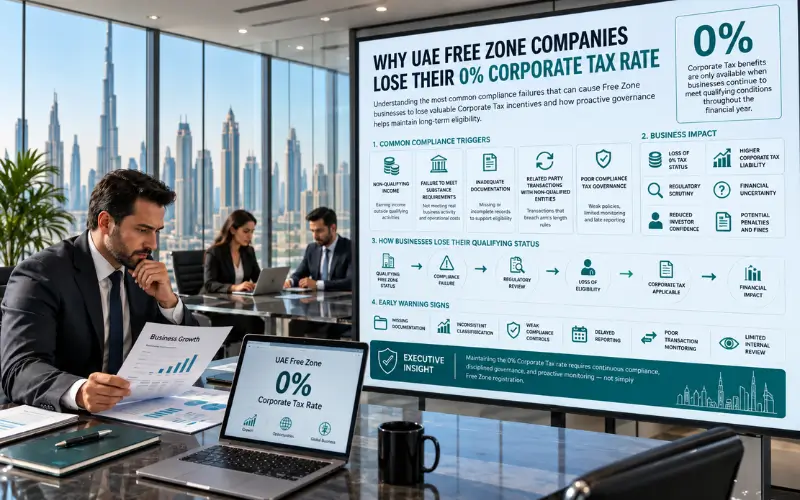
A JAFZA trading firm earns AED 14 million a year. Solid business. Clean books. Then an audit finds AED 800,000 of that came from mainland clients just 5.7% of revenue. That tiny slice cost them their whole 0% rate. A tax bill near AED 1.2 million followed.
Most Free Zone owners think 0% tax is automatic. Set up in the right zone, and you’re done, right? Wrong. Good tax compliance services exist for exactly this reason: the rate depends on meeting strict rules, every single year, not just at sign-up.
This guide covers the real triggers that strip Free Zone firms of their 0% rate. And how to dodge them.
Understanding the UAE’s 0% Corporate Tax Rate for Free Zone Companies
Why Free Zone Companies Can Benefit from a 0% Rate?
The perk exists to draw in investment and boost growth in set zones. But it comes with strings attached. Meet the rules, keep the rate. Slip up, and it’s gone.
What Is a Qualifying Free Zone Person (QFZP)?
Only a QFZP earns 0%, and only on Qualifying Income. Every other dirham gets taxed at 9%. This status isn’t a badge you win once. It gets tested, again and again.
Does Every Free Zone Company Automatically Qualify?
No. Setting up in a Free Zone does not guarantee a permanent 0% rate. You have to actually meet the rules, year after year, not just tick a box at launch.
The Most Common Reasons Free Zone Companies Lose Their 0% Rate
The De Minimis Trap
This is the big one. Non-qualifying income can’t top the lower of AED 5 million or 5% of total revenue. Go even AED 1 over, and QFZP status is gone. Not just for that year for the next four years too. All income then gets taxed at 9%, not just the bit over the line.
Selling to Mainland Customers
Mainland sales usually count as non-qualifying income. Unless the activity itself sits on the approved list, like some manufacturing or Designated Zone work. One growing mainland client can quietly push revenue over the line before anyone spots it.
Weak Bookkeeping and Records
QFZPs need audited statements every year. Poor records make it near impossible to prove qualifying versus non-qualifying income cleanly. That gap alone creates real audit risk.
Missing Registration or Filing Deadlines
Returns are due nine months after your year ends 30 September 2026, for a calendar-year firm. Miss it, and fines stack fast, no matter your actual tax bill.
Weak Transfer Pricing Documentation
Related-party deals need real paperwork behind them. Skip this, and even clean qualifying income gets hard to defend under review.
Quick risk table:
| Trigger | Risk Level | Preventive Action |
| De minimis breach | High | Check income mix each quarter, not once a year |
| Mainland sales growth | High | Track mainland revenue as it comes in |
| Weak records | Medium | Keep audited statements up to date year-round |
| Missed filing | Medium | Mark every deadline early |
Qualifying Income vs Non-Qualifying Income
Qualifying activities cover things like manufacturing, trading of set commodities, fund and wealth management, and Designated Zone distribution. Excluded activities cover most work with individuals, UAE-regulated banking and insurance, and income from UAE property.
| Business Type | Typical Qualifying Income | Common Risk |
| Trading company | Goods sold to other Free Zone or foreign firms | Mainland client growth |
| Consulting firm | Fees from clients abroad | Local UAE client work |
| Tech company | Software services to overseas clients | Domestic contracts |
Can Your Business Activities Affect the 0% Rate?
Selling to mainland buyers, offering services outside the Free Zone, and related-party deals all carry real weight here. New revenue streams, taken on without checking how they’re classed, are one of the fastest ways to drift past the de minimis line often without anyone noticing until it’s too late.
How to Protect Your Free Zone Tax Status?
- Check your business activities often, not just at year-end
- Track your income mix all year round
- Keep clean, audited financial records
- Hold onto contracts, invoices, and board notes for at least seven years
- Run a compliance check once a year, at minimum
- Get advice before a big business change, not after
Free Zone vs Mainland Corporate Tax
| Factor | Free Zone (QFZP) | Mainland |
| Rate on qualifying income | 0% | 9% above AED 375,000 |
| Ongoing conditions | Strict, ongoing | Simpler, standard rules |
| Audit requirement | Must-have | Only above AED 50m revenue |
Practical UAE Business Scenarios
A trading company moving into mainland UAE didn’t track the new sales apart from the rest. A dual-licence setup and clear income tracking kept its status safe.
A technology company with mostly overseas clients took on one local deal without checking the effect. Keeping an eye on the income split kept it well under the de minimis line.
A consultancy serving both Free Zone and mainland clients split its contracts to separate income lines clearly, protecting its rate going forward.
Is Your Business at Risk? A Quick Health Check
- Have your business activities shifted lately?
- Is qualifying income actually tracked, or just assumed?
- Are your books complete and audited?
- Have your tax filings gone in on time?
- Are related-party deals properly written down?
Common Mistakes That Put the 0% Rate at Risk
Assuming sign-up alone locks in the rate is the classic slip. Waiting until year-end to check compliance is another by then, the damage is often already done. Poor bookkeeping, thin paperwork, and ignoring shifts in business activity all quietly stack up until an audit brings it to light.
Common Myths About Free Zone Corporate Tax
| Myth | Fact |
| Every Free Zone firm automatically qualifies | Only a QFZP meeting strict rules qualifies |
| Sign-up means no return is needed | Returns stay mandatory, even at 0% |
| One slip instantly kills the rate | True for de minimis, but the full picture always matters |
| Tax compliance services are only for big firms | Small firms often have the least room to get it wrong |
Conclusion
The 0% rate brings real gains, but it hinges entirely on staying compliant, not a one-off setup job. Most firms lose it through slips they could’ve dodged, a missed threshold, thin records, a mainland contract nobody reviewed, not through deliberate rule-breaking.
Dubai Business & Tax Advisors helps Free Zone firms check their standing for the 0% rate, review income streams for de minimis risk, and firm up the paperwork that protects QFZP status year after year. Regular checks and solid tax compliance services, brought in before big changes rather than after, protect the rate that makes your Free Zone setup worth it in the first place.
Read Also: Boulevard point downtown Dubai
Frequently Asked Questions
Can a Free Zone company actually lose its 0% Corporate Tax rate?
Yes, and it happens more often than owners expect. Most cases trace back to a de minimis breach or mainland income wrongly classed, not deliberate rule-breaking. One growing client tie, tracked poorly, is often all it takes. Once lost, the status stays lost for that year plus the next four.
Do Free Zone companies still need to file Corporate Tax returns?
Yes, always, even at a 0% rate. Filing sits apart from paying. It’s still required no matter your tax bill. Skipping the return because “we owe nothing” is a common, costly guess. The tax authority still expects it filed on time, every year.
When should a business seek professional advice on this?
Before any big change a new mainland client, an expansion, a fresh revenue stream not after. Once income’s earned and classed, your options shrink fast. Early advice often marks the gap between a small fix and a five-year tax hit. Treat it as planning, not clean-up.
What happens if a company loses QFZP status partway through the year?
The loss covers the whole tax period the breach happened in, not just the part after the line got crossed. That means all income for that year gets taxed at 9%, even income earned before the breach. This backward-reaching effect catches many firms off guard, since they assume only the extra bit gets taxed. It’s exactly why tracking income all year beats a single check at year-end.
Can a company regain QFZP status after losing it?
Yes, but only after sitting out the current period plus the next four at the standard rate. A retest kicks in during year six, and the firm has to show it meets every rule again, from scratch. This isn’t a quick fix.it’s a real multi-year cost that makes stopping the breach far cheaper than fixing it after. Firms in this spot usually gain from a full compliance check before trying to requalify.