


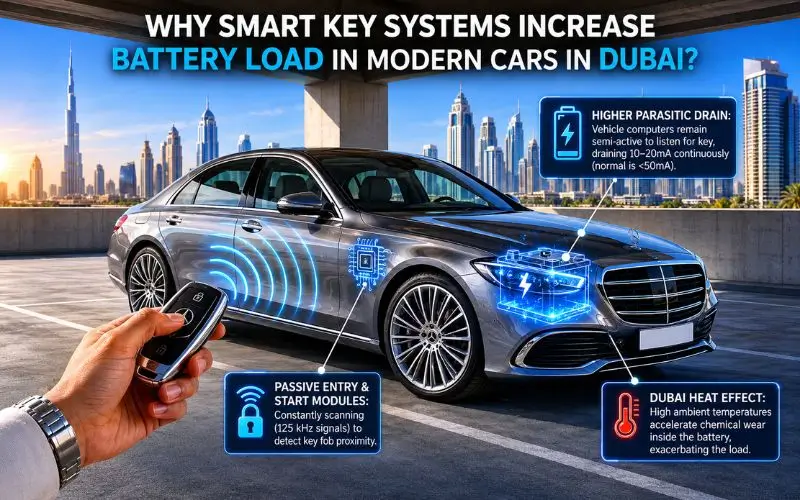
Smart key systems drain the battery of your car continuously. This constant electrical load can kill batteries much faster in Dubai’s extreme heat than drivers would expect.
In Dubai, every modern car runs a background procedure 24 hours a day and 7 days a week. This process is the smart key system and it runs continuously. Even with the engine turned off, a Nissan Patrol or Toyota Land Cruiser outside Dubai Mall draws power from the battery. Understanding how smart key systems can increase battery load will help you protect your battery from the harsh conditions in Dubai.
What is a smart key system and how does it work?
Smart key systems are electronic ignition and access systems. The system allows drivers to unlock, start and drive their car without having to insert a physical key. The vehicle constantly scans for an authorized keyfob within a 5- to 10-foot range. It will then disarm the immobilizer and unlock the doors, as well as enable the push button start.
Each smart key system is built on three core hardware components.
- The key fob contains a small chip transponder and a coin-cell battery CR2032
- The antenna modules are placed in the exterior and interior of the car to detect radio signals from the fob.
- The BCM is the electronic brain of your car that manages authentication and executes commands
Older remote entry systems were activated only when you pressed the button. Smart key systems operate differently. Smart key systems scan for the fob at a low frequency of 125 kHz whether you’re inside the vehicle, walking towards it or 50 meters in a garage. Smart key systems are more battery-hungry because they poll continuously.
Smart Key Systems: 6 Ways to Increase Battery Consumption
Smart key systems are powered by 6 different electrical demands. They are often used simultaneously.
1. Continuous Antenna Polling
Even when the engine is turned off, the antenna network transmits LF radio waves at 125 kHz. While parked, most vehicles poll every 2-5 seconds. This is between 17,000 to 43,000 polling occasions per day. Each polling event creates a small flow.
The total amount is substantial over 24 hours. The keyless entry module must be active at all time to receive the signal from the fob the moment you arrive. ( Source : Clore Automotive Parasitic Drawing Guide )
2. Body Control Module Wake Cycls
BCM does not completely shut down between elections, but it rests. Each poll triggers a BCM cycle. This is a real but short surge of current.
BCMs are also used in luxury vehicles, such as Mercedes-Benz, Audi and Lexus, that are common in Dubai. They track alarm sensors, cabin temperatures, and tire pressure. Each additional system increases the drain.
3. Keyless Entry Antenna Amplifiers
Smart key systems utilize signal amplifiers to increase range and reduce interference. In a typical car, 3 to 6 amplifiers are installed. All amplifiers require constant standby power. The car will never turn off because it must be ready to respond as soon as you approach.
4. Remote start and pre-conditioning features
In Dubai, many cars are equipped with remote climate preconditioning. The driver uses it to cool down the cabin prior to entering. It is especially useful when parking outside in Deira or Al Quoz raises the cabin temperature to 70degC. The 12V battery is used to power the remote start. This feature allows a channel to be open even in standby mode between the transmitter and receiver.
5. Maintenance of the Capacitor for Push-Button Starts and Relays
When parked, the push-button ignition will keep relays and capacitors running. You can start your car instantly by pressing the button. These circuits draw current throughout the day when they are in standby. It is a small amount per second but it does not stop.
6. Key Fob Authentication Codes, Logging and Security Codes
Smart key systems employ rolling security codes, which change each time they are used. The BCM keeps track of every code change, is in sync with the fob and checks the security circuit. The battery is loaded with many cycles.
Why Dubai’s climate multiplies smart key battery drain?
Dubai’s environment is not only a challenge for drivers. The environment in Dubai accelerates any electrical problems that are already present in vehicles. In a European climate, it can take 3 months for battery drain to be noticeable. But in Dubai’s summer heat, the same problem could appear within 3 to 6 week.
Extreme heat can cause the main car battery to degrade faster
Battery Energy (Prasad et al. 2023) published research that confirms lead-acid batteries’ life decreases by approximately 50% for each 10degC increase above the optimal operating temperatures.
Battery University’s thermographic data indicates that a sealed, lead-acid battery with a 10 year rating at 25degC will only last 30 months when the temperature is constant at 41degC. Dubai’s under-hood temperature in the summer months exceeds this threshold.
In UAE, a standard flooded-lead-acid battery will last 1.5 to 2 Years. AGM batteries last 3 to 4 years. The reserve capacity of a battery that has been weakened by heat is less. The small background drain of a healthy battery can become a major drain if the battery is heat damaged.
The high cabin temperature destroys key fob batteries faster
In the summer, interior temperatures in a car parked in the UAE can reach 70degC. The battery life of the key fob is significantly reduced. The fob will send weaker signals when the battery is weaker.
The antenna amplifiers draw more power to try and detect the signal degradation. The cycle is created: heat weakens your fob, it transmits less, the car amplifies more, and the battery drains quicker.
Short commutes prevent full battery recharge
Dubai’s driving habits, such as short trips between Al Barsha, Downtown, or Jumeirah to go to school, means that the alternator is rarely run long enough for a battery to be fully recharged after it has been depleted overnight by parasitic drain. This problem is exacerbated by heavy traffic and idling.
In Dubai, there are 4 common signs that your smart key system is draining your battery.
Avoid being stuck at the Dubai Mall, Dubai International Airport or on E311.
- Key fob range reduced: Standing within 3 meters instead of 5-10 feet is a sign of a weakening key fob or battery.
- Delayed start after overnight parking. A clicking or hesitating engine after parking under the sun indicates overnight parasitic drain.
- If the car doesn’t respond to the first button press, it is likely that the circuit for the smart key communication isn’t getting enough power.
- If you press the fob against the button, the signal strength will be reduced.
Dubai drivers must know about smart key systems and battery types
AGM batteries should be used in cars with smart keys. They can handle the partial discharge patterns created by electronics that are always on. AGM batteries are resistant to sulfation. This is the process of crystallization that reduces capacity permanently after repeated shallow discharges.
In Dubai, it is common to install a flooded AGM battery in a vehicle that was designed for AGM. This disables the start-stop feature, causes repeated battery warnings and results in early failure. A combination of UAE heat and continuous smart system drain will cause a flooded car battery to fail in 18 months.
Modern vehicles send battery information to the ECU. If you replace a battery and don’t register it with the ECU, the car will charge the new battery using the degraded profile of the old unit. This overcharges the battery and damages it. When replacing a battery, always request ECU registration.
How to reduce the battery drain on smart key systems in Dubai
These 7 steps will help you reduce the battery drain on your smart key system for Dubai driving conditions.
- When possible, park in a covered or shaded lot. The interior temperature of covered lots at Dubai Metro Stations is 15 to 25degC lower than open-air parking.
- Never leave your key fob in the car. In the UAE, a fob left inside a vehicle in summer heat will trigger constant close-range authentication and drain the battery quickly.
- Replace the key fob batteries every 12 months. In cooler climates, replace the CR2032 battery every 18-24 months. However, Dubai’s heat requires annual replacement.
- Drive longer distances periodically. Take a 30- to 40-minute drive on the Sheikh Mohammed Bin Zayed Road at least twice a week if your daily commute is less than 20 minutes. This will allow the alternator time to recharge the battery.
- When not required, disable remote start standby. If you park your vehicle in a garage with a cover, turn off the remote preconditioning standby.
- Install a battery monitor. Clip-on voltage meters that sync with a smartphone application give real-time warnings before a failure.
- Test your battery before the peak heat of June to September, when temperatures along Al Khail Road can reach up to 45degC.
When Should You Replace Your Car Battery In Dubai?
Do not wait until your battery fails to replace it. Instead, follow these intervals specific to Dubai.
Battery Replacement Interval in Dubai: Standard Flooded lead-Acid every 18 months. EFB Battery every 2 to 2.5 year. AGM Battery: Once every 3 to 3.5 year. Lithium Auxiliary Batteries: Every 4 to 5.
If the vehicle is parked outside daily in Dubai during the summer, it should be replaced between 3 and 6 months prior to the upper range of this range.
What Sayara Battery recommends for Dubai drivers with Smart Key Systems
Sayara Battery is often surprised to see Dubai drivers who are shocked that their 2-year-old vehicle has a dead or dying battery. Most of the time, the smart key parasitic drainage combined with Dubai heat is to blame, and not a defect in manufacturing.
Sayara Battery’s 5 most important recommendations include:
- Install the AGM battery specified by your vehicle’s manufacturer. Never use a cheaper flooded battery.
- Every time you replace an ECU battery, request the registration. Modern smart key equipped vehicles must comply with this step.
- Do not just check the voltage, but also conductance.
- Replace your keyfob battery every year to avoid the antenna amplification cycles that compound the main battery drain.
- Choose underground or shaded parking, particularly from June to September.
Sayara Battery can provide a professional battery diagnosis if your push button start hesitates, if your key fob’s range has decreased, or if your dashboard displays any electrical warning. Our mobile battery replacement service covers all of Dubai from Deira, Dubai South, Jumeirah and Al Quoz.
Sayara Battery offers professional Bosch battery change in Dubai services, ECU Registration, and Electrical Diagnostic Services. We can deliver and install batteries at your office, home or roadside.
Read Also: Smart Guide to Dnata Staff Travel Benefits and Booking Process
